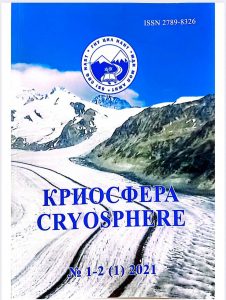



For all scientists and specialists’ information in the field of glaciology that the scientific journal of the “Institute for the Study of Glaciers and the Cryosphere of the National Academy of Sciences of Tajikistan” announces the acceptance of articles and reviews, as well as reports of scientists and specialists both within the country and abroad, publications in the field of cryosphere, glaciers, climatology, meteorology, hydrology, ecology and sanitatio in Russian and English. Only articles on the issue of glaciers will be accepted; other sections will not be accepted. All local and foreign scientists and specialists are invited to send their scientific works and articles to the e-mail abdkayumovcryos@gmail.com or to the address Dushanbe, Rudaki Avenue 33 (tel.: 939999272). A signed print version is required. Cooperation with you is your contribution to the development of glaciers and the provision of scientific information about modern glaciers, especially the glaciers of the Republic of Tajikistan and the world.

For authors
Rules for article configuration submitted to the journal “CRYOSPHERE” of the State Scientific Institution “Center for Glacier Research of the National Academy of Sciences of Tajikistan” for publication
The journal “Cryosphere” of the State Scientific Institution “Center for Glacier Research of the National Academy of Sciences of Tajikistan” covers original and most significant results of scientific research in the field of cryosphere, glaciology, climatology, meteorology, hydrology, ecology and sanitation.
The journal is registered with the International Center for the Registration of World Periodicals and has the print ISSN 2789-8326. The journal is included in the eLIBRARY.RU Scientific Electronic Library—Russia’s largest information and analytical portal in the field of science—and is also integrated into the Russian Science Citation Index (RSCI).
Article configuration
The article should be written in a concise form, well edited and carefully checked. The manuscript should be submitted in Tajik, Russian or English as a file in MS Word format (.doc or .docx), in standard Times New Roman font, 14 point font, with one and a half line spacing.
The maximum allowed length of the article is 14 pages or 40000 characters including spaces. Figures are also taken into account in the volume of the article (a figure per page is equal to 1800 characters). The volume of commissioned articles is determined by the editorial staff.
Lines within a paragraph should not be entered manually (“soft” input, spaces, tabs, etc.). The end-of-paragraph symbol (¶ – “Enter”) should be placed only at the end of a paragraph.
Do not type more than one space between words, do not space within a word, do not indent paragraphs with paragraph indents, do not separate punctuation marks with spaces from the preceding word. There should be no hyphenation in words.
The beginning of the article in the original language is indented:
- Universal Decimal Classification (UDC) number
- Author’s initials and surname (capital letters)
- Title of the article (capital letters)
- Name of the organization where the work was completed (first author)
- Short abstract (150-250 words)
- Key words (3 – 5)
- At the end of the article, information is provided in English and Tajik in the same sequence.
The article should contain:
- short introduction
- research objective
- materials and methods of research
- research results and discussion
- conclusion
- list of references
The file with the text of the article should contain the following information about the author(s):
- Full list of authors (initials and surnames). It is necessary to indicate which of the authors is responsible for the correspondence.
- The main place of work of each author (if any) in nominative case, position held, academic degree, title of the author(s). If the authors work in different organizations, it should be clear who works in which organization. If all authors of the article work or study in the same institution, it is possible not to indicate the place of work of each author separately.
- E-mail address of the author responsible for correspondence.
Example of drawing caption. Figure 1. Title of the figure. (centered). Figure title. (placed in the center)
Figure 2. Title of the figure. (Times New Roman, font size 12)
Tables and formulas
Formulas, tables and schemes are organized using the standard toolbar.
Example of table titles,
Table 1.
Table title. (placed above the table, centered)
Table 2
Table title
A reference to the main source is indicated under the table
List of references
The reference list should contain bibliographic information about all publications mentioned in the article and should not contain references to works that are not cited in the text. References to unpublished works are not allowed. References in foreign languages remain in the original version.
References to the cited literature are given in square brackets, e.g.: [1], [1,3-5]. The list of references is given in a general list (under the heading “Literature”) in the order of mentioning in the text and is arranged as follows:
For books: author’s surname and initials, full title of the book, place of publication, publisher, year of publication, volume or issue, total number of pages.
For periodical publications: surname and initials of the author, title of the publication, year of publication, volume, number, first and last pages of the article:
A dash is placed before the place of publication, a colon between the place of publication and the publisher, a comma before the year of publication, and a dash before the name of the journal.
For example:
- Долгушин Л.Д., Осипова Г.Б. Природа Мира. Ледники. – М.: Мысль, 1989, -448 с.
- Котляков В. М. Подвижки ледников Памира в первые 20 лет XXI века / В. М. Котляков, Л.В. Десинов, С.Л. Десинов, В.А. Рудаков // Доклады Российской академии наук. Науки о Земле. – 2020. – Т. 495. – № 1. – С. 64-68..